
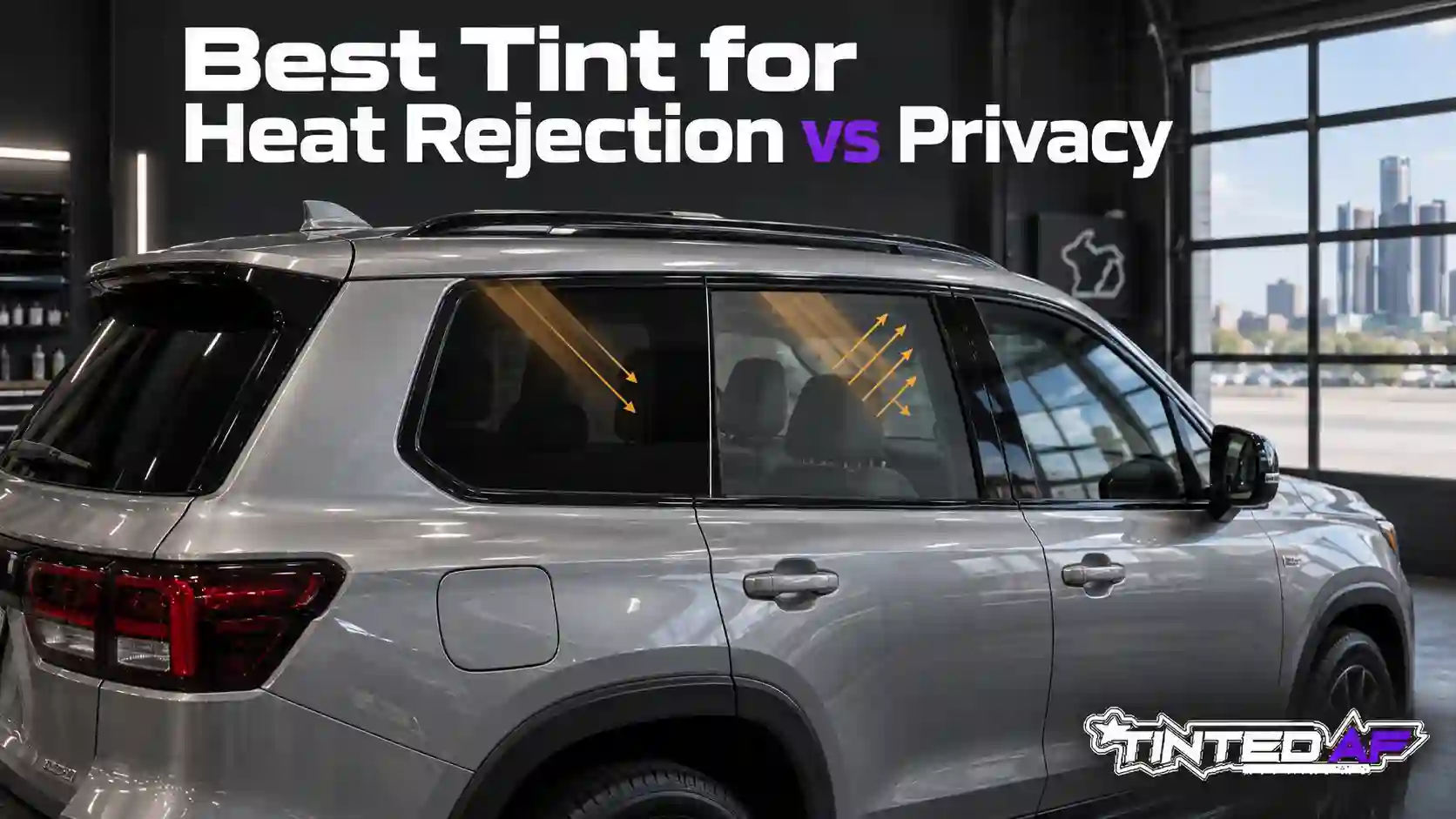
Drivers shopping for tint want two things at once. They want a cabin nobody can see into, and a dashboard that stays cool in July. Comparing tint for heat rejection vs privacy comes down to VLT percentage and film technology. Darkness alone does not decide the outcome. This guide breaks down what each film type actually blocks in Sterling Heights and Dearborn Heights driving conditions. Then it shows how TintedAF’s window tinting installers match the right combination to Michigan weather.
Why Drivers Search for Both Privacy and Heat Rejection in One Tint
Michigan summers push cabin temperatures well above the outside air within minutes of parking. Metro Detroit traffic also means hours of visibility into passing cars. Most tint searches blend both concerns into one decision.
Heat rejection and privacy are measured differently, though. Heat rejection depends on infrared blocking technology inside the film. Privacy depends almost entirely on how dark the film reads from outside.
How Heat Rejection Is Actually Measured: TSER, IR Rejection, and VLT
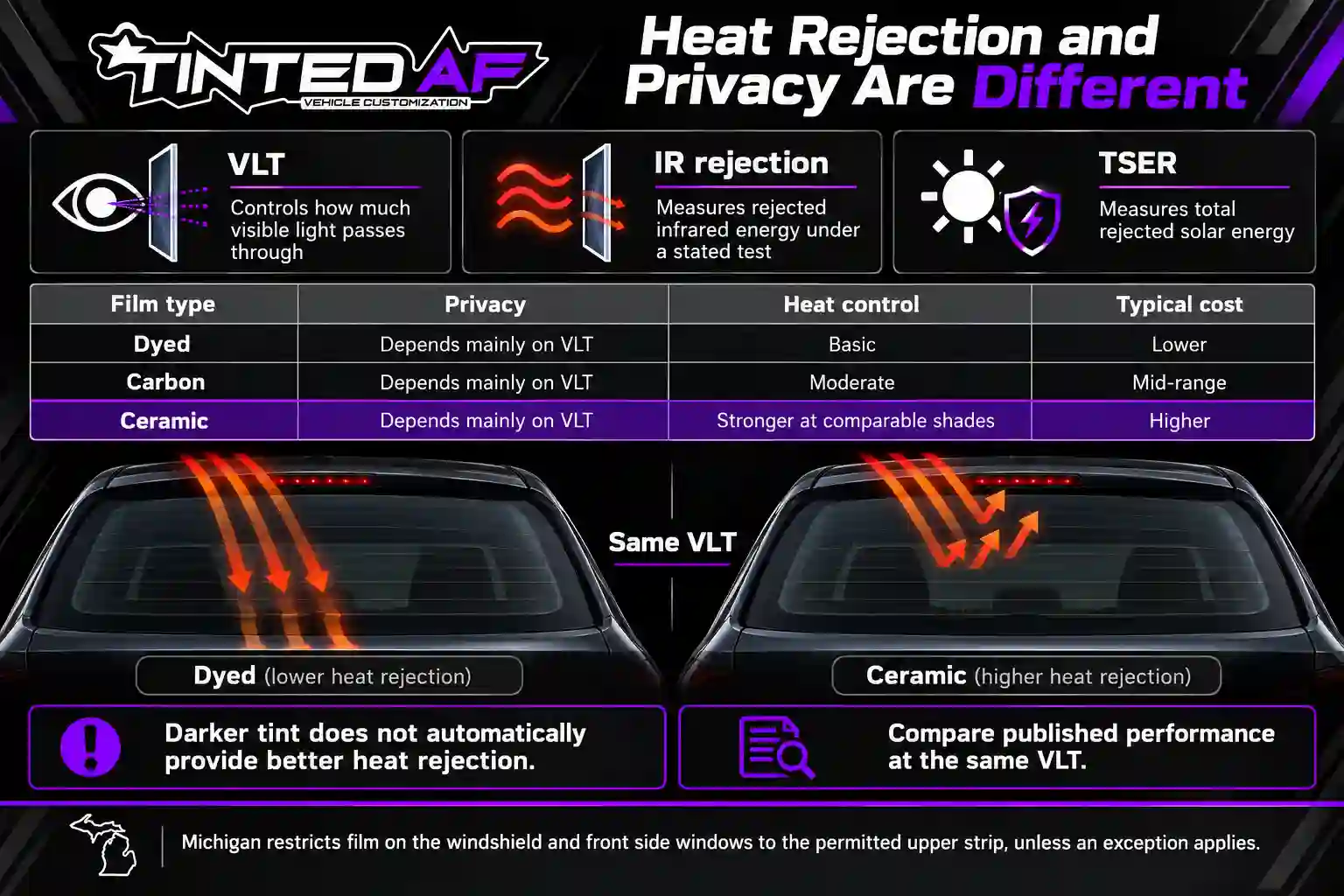
Total solar energy rejected, or TSER, measures how much combined heat a film blocks. Infrared rejection measures only the invisible heat wavelengths responsible for most cabin warming. Visible light transmission, or VLT, measures how much light and image pass through the glass.
Installers at TintedAF test all three numbers before recommending a film, not just VLT darkness. A film with strong IR rejection can feel noticeably cooler even at a lighter shade. That combination is often what separates a good tint job from a disappointing one.
Does a Darker Tint Actually Block More Heat
Not necessarily, and this is the most common misconception in tint shopping. Two films at the same 20% VLT can perform very differently against heat. Film technology, not darkness, determines how much infrared it actually blocks.
A cheap dyed film mostly absorbs heat into the glass itself. A ceramic film reflects and blocks that heat before it fully transmits. That is why a lighter ceramic film can outperform a darker dyed film on a hot afternoon.
Showroom comparisons often mislead shoppers, since a darker sample simply looks more premium. A meter reading tells a more accurate story than a glance through the window. Asking for the actual TSER or IR rejection number avoids that mistake entirely.
Tint Percentages Explained: What 5%, 20%, 35%, and 50% VLT Really Do
VLT percentage tells installers how much light a film lets through. It is the fastest way to compare privacy across different films. Michigan law does not cap rear window darkness, so drivers can legally choose almost any shade behind the front doors.
For a deeper breakdown of every tier, TintedAF publishes a full guide to choosing the right VLT percentage. It covers glare and nighttime visibility at each shade.
5% VLT: Maximum Privacy, Minimal Extra Heat Rejection
Only about 5% of light passes through, close to limousine tint. Privacy is maximum, but nighttime visibility drops noticeably.
20% VLT: Strong Privacy Without Killing Visibility
Twenty percent blocks a direct view into the cabin during the day while keeping mirrors usable at night. It is a common pick for daily drivers who still want strong heat rejection.
35% VLT: Michigan’s Most Requested Shade
Thirty-five percent is Michigan’s most requested shade for front doors. It is also a popular ceramic film choice for heat rejection. It balances a darker look with dependable low-light visibility.
50% VLT: Heat Rejection First, Privacy Second
Fifty percent VLT prioritizes heat and UV rejection over darkness, and works well paired with ceramic film. Privacy is lighter, closer to factory tint than aftermarket film.
Dyed vs Carbon vs Ceramic: Which Tint Wins for Heat Rejection
Each film type manages heat differently, and the differences show up fast on a 90-degree day. The table below compares typical performance ranges reported across the industry.
| Film Type | Infrared Heat Rejection | UV Protection | Signal Interference | Typical Lifespan |
| Dyed | Low, mostly absorbs heat | Up to 99% | None | 2 to 5 years before fading |
| Carbon | Moderate, 40% to 60% reported | Up to 99% | None | 5 to 10 years |
| Ceramic | High, 70% to over 90% reported | Up to 99% | None, non-metallic | 10+ years, often lifetime warranty |
Ceramic consistently wins on heat rejection and long-term clarity, which is why most heat-focused searches point toward it. Carbon remains a solid mid-range option for drivers who want better heat control without the ceramic price jump.
Does Ceramic Tint Interfere With GPS, Phone Signal, or Toll Transponders
Older metalized films could weaken GPS, cell signal, and toll transponder reception inside the cabin. Ceramic and carbon films use nano-ceramic or carbon particles instead of metal, so they do not carry that risk. Signal strength stays effectively the same before and after installation.
Dyed film carries no metal either, so it shares that same signal-safe profile. The only films worth double-checking are older metallic or hybrid products, which have mostly disappeared from the market. A reputable installer can confirm the exact film composition before booking.
Can One Tint Really Deliver Both Privacy and Heat Rejection
Yes, when the film pairs a mid-range VLT with ceramic technology. A 20 or 35 percent ceramic film blocks most infrared heat while still reading dark from outside. The combination avoids the trade-off drivers worry about most.
Dyed film cannot match that performance at any shade. It blocks light for privacy but does very little against infrared heat. Ceramic remains the only film type built to solve both problems at once.
Car Tint You Can See Out But Not In: How It Actually Works
Daytime privacy tint relies on a simple light difference. Outside light is far brighter than the light inside a tinted cabin. That difference makes the glass act almost like a one-way mirror from outside looking in.
Occupants can still see out clearly because their eyes adjust to the darker interior, not the bright exterior. At night, that advantage flips. Interior lights or phone screens can make the same tint far easier to see through from outside.
Parking under bright lot lighting or leaving a dome light on erodes privacy the same way. Keeping cabin lighting low after dark preserves most of the daytime privacy effect. This is a habit, not a film upgrade, and it costs nothing to adopt.
Michigan Tint Laws: What’s Legal for Windshields and Side Windows
Michigan allows unlimited darkness on rear side windows and the back windshield, but front windows are more restricted. Aftermarket film on the front side windows and windshield is limited to a narrow strip along the top edge. Reflectivity is also capped at 35 percent on front and rear side windows.
Drivers chasing the darkest legal rear tint can check this guide to Michigan’s darkest legal tint for exact limits. Windshield tint for heat is legal only in that same top strip. Most windshield heat rejection instead comes from a separate solar film, not dark tint.
What Window Tint Costs in Michigan for Heat Rejection and Privacy Upgrades
Film type has the biggest impact on price, more than shade or brand. Dyed film costs the least but delivers the weakest heat rejection of the three options. Ceramic costs more upfront but usually pays that back through better heat rejection and a longer-lasting finish.
Exact sedan and SUV pricing for each film type appears in this 2026 Michigan window tint cost guide. Most Michigan drivers pay $ 250 to $ 500 for a full sedan tint in 2026.
Why Professional Installation Changes Heat Rejection Performance
Heat rejection film only performs to spec when it is applied without bubbles, gaps, or trapped dust. A poor install traps moisture, which clouds the film and reduces both clarity and infrared performance over time. Edge lifting also lets UV and heat leak in around the frame.
Computer-cut patterns and a controlled installation space matter more than most drivers realize. A precise cut avoids the gaps where heat and glare slip through untreated glass. That precision is also what makes a lifetime warranty possible.
A warranty is only worth as much as the shop standing behind it. Asking whether the warranty covers bubbling, peeling, and color shift separates a strong guarantee from a thin one. That detail matters more once a film is several summers old.
The Science Behind Heat Rejection: What Solar Heat Gain Coefficient Means
Solar heat gain coefficient, or SHGC, measures the total solar energy that passes through a window or film. A lower SHGC means less heat reaches the cabin, even before air conditioning kicks in. Reflection and absorption are the two mechanisms film uses to lower that number.
The National Fenestration Rating Council’s guide to window film explains this mechanism in detail. It covers the trade-offs between reflective and absorptive film types. It is a useful independent reference for drivers who want the engineering behind the marketing claims.
Absorptive films, like most dyed products, still raise glass temperature even while cutting glare. Reflective films, like ceramic, keep more heat from reaching the glass in the first place. That distinction explains why two tints with similar darkness can feel completely different inside the cabin.
Conclusion
Heat rejection and privacy come from different parts of a film, not from darkness alone. Ceramic film paired with a mid-range VLT delivers strong results on both fronts. Dyed and carbon films still have a place, but mostly on tighter budgets.
Choosing between heat rejection and privacy gets easier with a shop that clearly explains both trade-offs. TintedAF walks Metro Detroit drivers through VLT, film type, and legal limits before any film touches the glass. To see what’s legal on every window, review Michigan’s complete window tinting laws before booking an appointment.
Frequently Asked Questions
1. What tint percentage gives the best privacy without killing heat rejection?
A 20 to 35 percent ceramic film usually strikes the best balance for Michigan drivers. It blocks a large share of infrared heat while still reading dark enough for daytime privacy. Night visibility stays workable at those shades, unlike 5 percent limo tint, which gets hard to see through after dark.
2. Does ceramic tint really block more heat than carbon or dyed film?
Yes. Ceramic film reflects infrared heat instead of absorbing it into the glass, so cabins stay noticeably cooler on hot afternoons. Dyed film blocks almost no extra heat beyond the base glass, and carbon sits in between. Ceramic also resists fading, so heat rejection holds up for years, not months.
3. Can I get a tint that blocks heat but still lets me see out at night?
Yes, ceramic film in the 20 to 35 percent range keeps night visibility usable while still rejecting heat well during the day. Very dark tints below 15 percent make it noticeably harder to see out after dark, especially with interior dome lights, oncoming headlights, or a phone screen on.
4. Is a darker tint always better for blocking heat in a car?
No, and this trips up plenty of shoppers who compare films by eye. Film technology matters more than raw darkness for heat rejection. A lighter ceramic film can block more infrared heat than a darker dyed film, since ceramic reflects heat instead of absorbing and re-radiating it inside the cabin.
5. What is the darkest legal tint for a car in Michigan?
Rear side windows and the back windshield have no VLT minimum in Michigan, so 5 percent or darker is legal year-round. Front side windows and the windshield allow only non-reflective film on the top few inches, regardless of how dark the film is rated by the manufacturer.
6. Does tinting the windshield actually help with heat in Michigan?
Only slightly, since Michigan law limits windshield film to a narrow top strip near the header. Most real windshield heat reduction instead comes from a separate clear solar film rated for full coverage, which blocks infrared without violating the state’s visible-light transmission rule.