
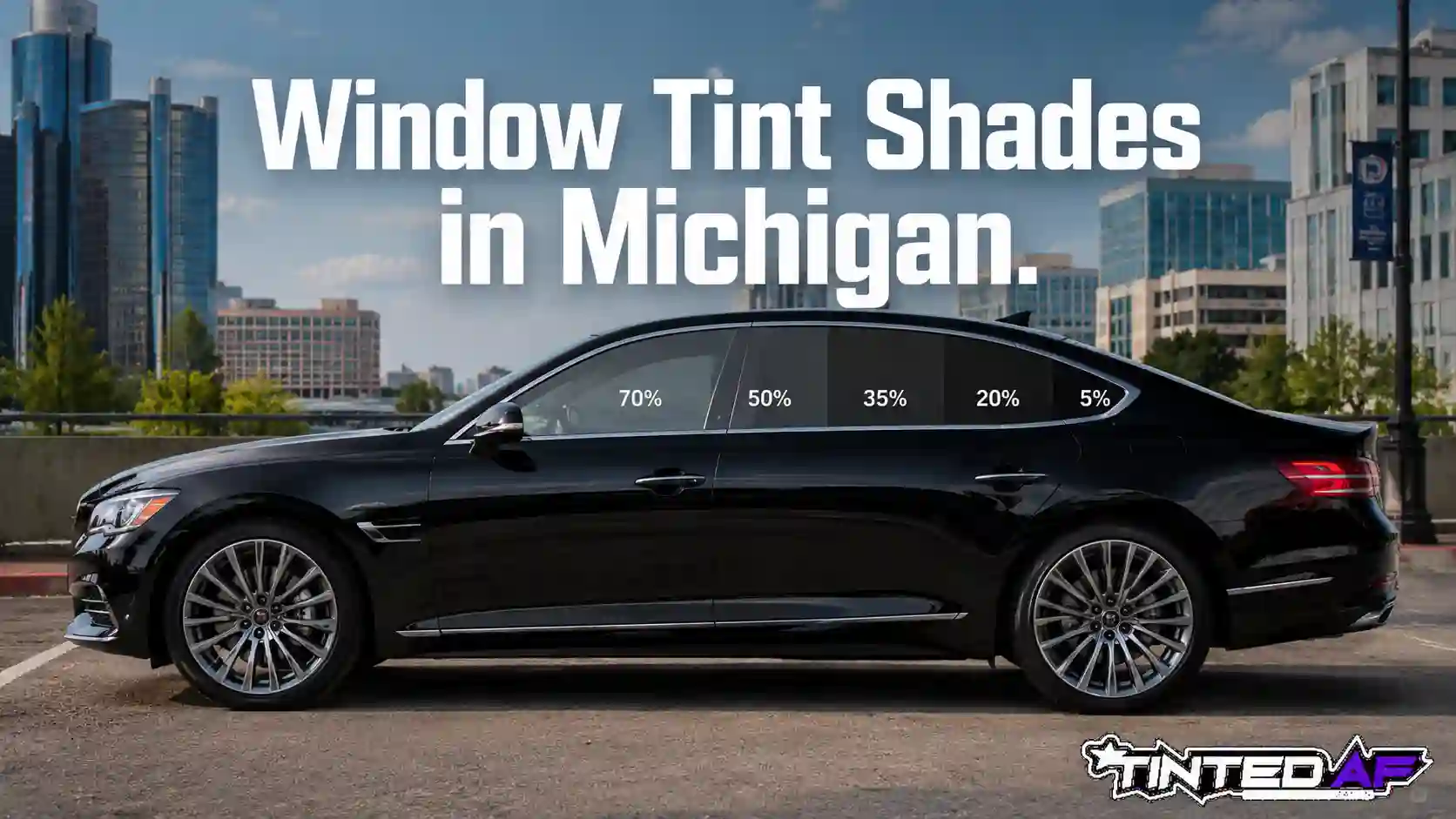
Window tint shades range from 5% limo dark to 70% nearly clear, showing how much light passes through the glass. At TintedAF in Dearborn Heights, drivers ask which shade fits their car before almost every appointment. This guide explains the shade chart, the scale, how tint is measured, and what Michigan law allows.
Which Window Tint Shade Is Right for Each Driver?
The right shade depends on the window, the main priority, and the law. Light shades such as 50% and 70% keep the strongest night visibility. Medium shades like 30% and 35% balance privacy and clarity, while dark shades like 5% and 20% maximize privacy.
Michigan sets no darkness percentage, but it limits tint to the rear windows and the top of the front sides. Shade choice therefore matters most on the rear glass. Drivers wanting a recommendation can book car window tinting services in Michigan and discuss shades in person.
What Does a Window Tint Shades Chart Show?
A shade chart lists each common percentage beside its appearance, its daytime privacy, and its night visibility. The table below compares nine popular shades, from the darkest to the lightest.
| Shade | Look From Outside | Daytime Privacy | Night Visibility | Typical Use |
| 5% | Near black | Highest | Poor | Maximum rear privacy |
| 15% | Very dark | Very high | Limited | Rear windows |
| 20% | Dark | High | Reduced | Strong rear privacy |
| 25% | Dark to medium | Moderately high | Reduced | Rear privacy |
| 30% | Medium | Moderate | Fair | Balanced rear look |
| 35% | Medium | Moderate | Fair | Common daily rear shade |
| 40% | Medium to light | Light | Good | Subtle privacy |
| 50% | Light | Low | Good | Glare control |
| 70% | Near clear | Minimal | Very good | Heat control with a clear look |
In practice, TintedAF treats the chart as a guide, not a promise. The same film looks different on every vehicle, so the result should always be confirmed on the actual glass.
How Does the Window Tint Scale Work?
The tint scale runs on visible light transmission, known as VLT. The number is the share of visible light passing through the film and glass. A lower number therefore means a darker window.
A 5% film lets only 5% of light through, while a 70% film lets 70% through. The scale is easy to misread, because a bigger number looks lighter, not stronger.
Each step on the scale changes the look by a different amount. The difference between 5% and 15% is dramatic, while the difference between 50% and 70% is subtle.
How Is Window Tint Measured?
A tint meter measures how much light passes through the window with the film applied. The reading includes the glass itself, so it is always lower than the film rating alone.
Most vehicles leave the factory with slightly tinted glass, and a good installer accounts for that before choosing a film. A common example is 35% film on glass that already passes 75% of light. The two numbers multiply, giving 0.75 times 0.35, or about 26%.
That multiplication explains why two cars with the same film can look different, so a meter reading confirms the result. TintedAF advises treating the finished reading as the final answer.
What Do Dark Shades Like 5%, 15%, and 20% Look Like?
A 5% film is limo dark and looks nearly black from outside in daylight. It gives the most privacy, but it sharply reduces what the driver sees at night.
A 15% film is very dark, and a 20% film is dark. Both hide most of the cabin in bright light, though interior details can show at close range.
Dark shades suit rear windows where privacy matters more than visibility. Night driving, parking lots, and backing up all become harder as the number drops.
What Do Medium Shades Like 25%, 30%, and 35% Look Like?
Medium shades give a visible tint without hiding the cabin completely. A 35% film is the most common daily choice because it looks clearly tinted while preserving reasonable clarity.
A 30% film is slightly darker and a 25% film is darker still. The visual step between 30% and 35% is small, so many drivers choose by price or film type.
Occupants stay partly visible in direct sun at these shades, and interior lights make them more visible at night.
What Do Light Shades Like 40%, 50%, and 70% Look Like?
A 40% film looks subtly tinted and keeps strong visibility. A 50% film is a light shade that reduces glare without changing the look of the car much.
A 70% film is nearly clear and gives minimal privacy. It is popular with drivers who want heat control without a visible tint, especially in ceramic film.
Lighter options exist, and installers can supply the exact specification for each product. The right choice depends on how much visual change the owner wants.
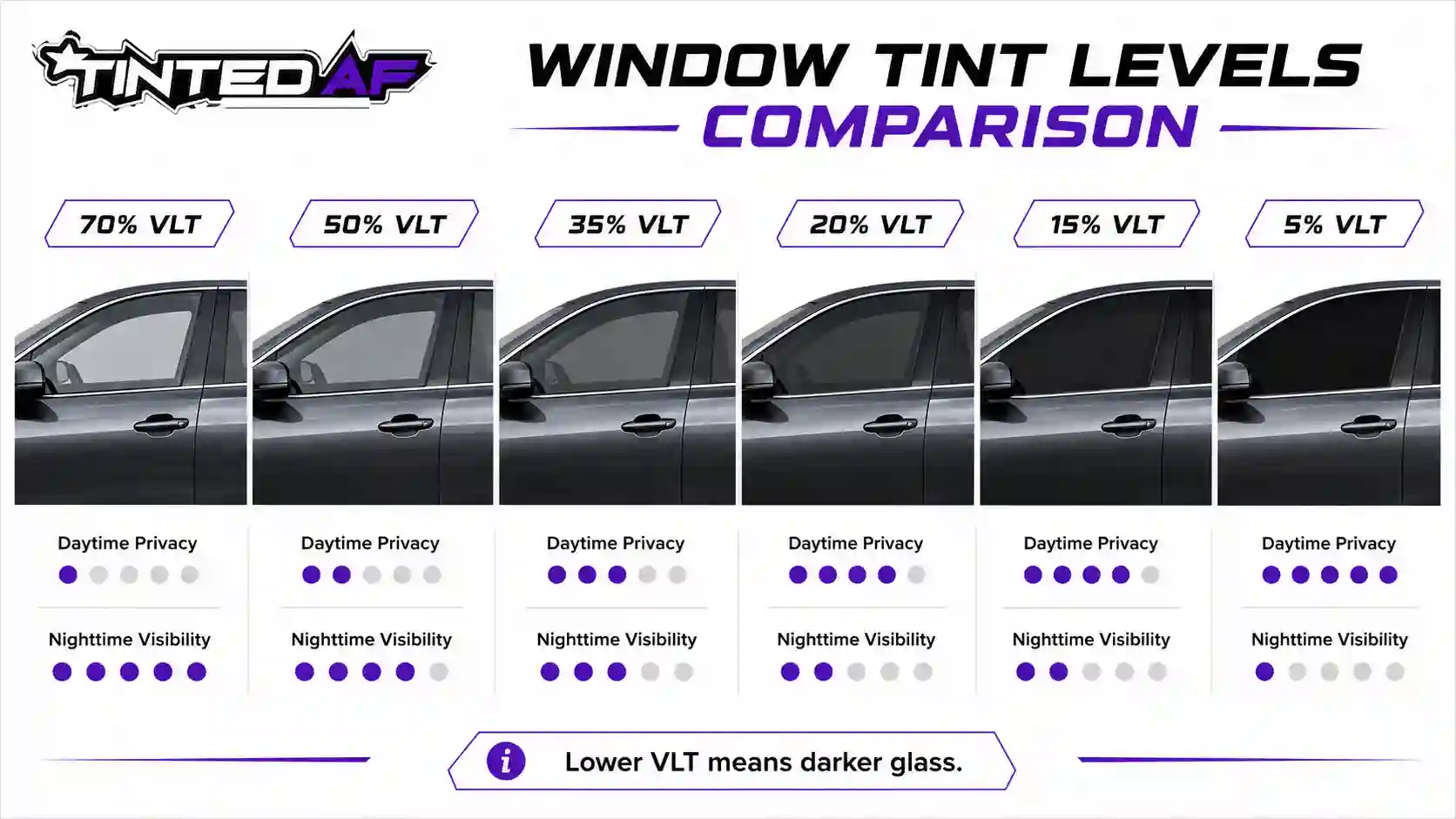
How Do Popular Shades Compare Side by Side?
Comparing two shades shows how much light each one lets through. A 35% film passes 1.75 times as much light as a 20% film, which is a visible difference at night.
A 50% film passes about 1.4 times as much light as a 35% film. A 70% film passes about 1.4 times as much as a 50% film. These ratios describe the film alone, before the glass is counted.
In practice, moving from 20% to 35% improves night visibility, while 50% to 70% mostly changes the look.
How Do Tint Shades Look From Inside and Outside?
From outside in daylight, darker film hides the cabin, while lighter film shows more of it. From inside, every shade looks lighter than it appears from outside, because the driver is looking toward brighter surroundings.
At night, the relationship reverses, and interior lights make occupants easier to see from outside, even through darker film.
This is why privacy and visibility must be weighed together. A shade that feels private at noon may feel less private after dark.
Does a Darker Shade Block More Heat?
Darker film of the same type often rejects more heat, but shade is only one part of the picture. Film type matters just as much, because ceramic and carbon films control infrared heat in ways that dyed film cannot.
A light ceramic film can therefore outperform a darker basic film. Heat should be judged by total solar energy rejected and infrared rejection, not by darkness alone.
Drivers who want heat control without a dark look can choose a lighter shade in a higher-performance film. The specification sheet shows the numbers for each product.
Which Shade Works Best for Night Driving?
Lighter shades work best for night driving, because more light reaches the driver’s eyes. A 50% or 70% film preserves visibility on dim roads, while 5% and 15% make it hard to read.
Rear windows matter at night because drivers use them when backing up and changing lanes. A very dark rear shade can make those moments harder.
Wet roads and glare strengthen the effect, so drivers who commute after dark should lean lighter on the rear glass.
How Do Factory Glass, Car Color, and Interior Change the Look?
Factory privacy glass is already tinted, so adding film makes the window darker than the film rating suggests. Vehicles with dark rear glass often need only a light film to match the front.
Car color and interior color change the look too, because light interiors show through film more than dark interiors.
Glass shape and window size also change the result. Large, curved windows can look different from small flat ones, even with identical film.
What Does Michigan Law Say About Tint Shades?
Michigan does not specify a darkness percentage for window tint. Michigan State Police guidance limits tint to the rear side windows and the top 4 inches of the front side windows.
The rear window may be tinted when the vehicle has outside mirrors on both sides. Michigan also prohibits applications with solar reflectivity above 35%, and a limited medical exception exists for the front windows.
This is why a percentage chart does not decide legality in Michigan, where placement and reflectivity set the rules. Shade is a personal choice on the windows that may be tinted.
Which Shade Should Drivers Choose for Rear Windows in Michigan?
Rear side windows and the rear window have no darkness limit in Michigan. The choice therefore comes down to privacy, visibility, and style. Shades such as 35% and 20% are common because they balance privacy with visibility.
Darker rear shades suit drivers who value privacy and carry valuables. Lighter rear shades suit drivers who often drive at night or back up in tight spaces.
Matching the rear shade to any existing factory privacy glass keeps the vehicle looking uniform. A sample against the glass makes the decision easier.
How Can Drivers Preview a Shade Before Installation?
The best preview is a film sample held against the actual glass in daylight. This shows how the shade interacts with the vehicle’s paint, interior, and window shape.
Drivers should also ask to see the same shade on a similar vehicle. Photos of finished work help, but a live comparison is more reliable.
Looking at the sample from inside matters too, since that view is the one the driver lives with daily.
What Shade Mistakes Should Drivers Avoid?
The most common mistake is choosing by number alone. Two films with the same percentage can look and perform differently, depending on type and glass.
Another mistake is assuming 35% is the Michigan limit, when Michigan regulates placement and reflectivity rather than darkness.
Ignoring night visibility is a third mistake. A shade that looks good in a showroom can be hard to live with on a dark road.
Final Thoughts on Choosing a Window Tint Shade
The right window tint shade balances privacy, night visibility, heat control, and appearance. Lighter shades protect visibility, darker shades add privacy, and film type decides how much heat is controlled. Michigan regulates placement rather than darkness, so the rear windows are where shade choice matters most.
Drivers who want the legal details can read about Michigan window tint laws for 2026 before choosing. TintedAF serves drivers across Metro Detroit from shops in Dearborn Heights and Sterling Heights.
Frequently Asked Questions
What do window tint percentages mean on the shade scale?
The percentage is visible light transmission, the share of visible light that passes through the film and glass. A 5% film lets 5% through and looks nearly black, while a 70% film lets 70% through and looks nearly clear. Lower numbers mean darker windows, which feels backward at first.
Is 5% window tint darker than 20% tint?
5% tint is much darker than 20% tint, because it lets through only 5% of visible light compared with 20%. A 5% film looks nearly black from outside and sharply reduces night visibility, while a 20% film is dark but allows noticeably more light through the glass in dim conditions.
Is 20% or 35% tint better for night driving?
A 35% film is better for night driving because it passes about 1.75 times as much light as a 20% film. Both shades reduce night visibility compared with lighter options. Drivers who commute after dark should consider 35% or lighter, especially on the rear glass where backing up demands clear sight.
What is the lightest window tint percentage?
A 70% film is among the lightest common shades and looks nearly clear. Lighter specialty films exist, and installers can provide each product’s exact specification. A nearly clear film suits drivers who want heat control without a visible change to how the vehicle looks from outside in daylight.
Does darker window tint block more heat?
Darker film of the same type often rejects more heat, but film type matters as much as shade. A light ceramic film can outperform a darker basic film, so total solar energy rejected and infrared rejection are better measures than darkness alone. The spec sheet lists those numbers for each product.
How does factory glass change the final tint percentage?
Factory glass already blocks some light, so the film percentage multiplies with it. A 35% film on glass that passes 75% of light measures about 26% after installation. A meter reading on the finished window confirms the final percentage for that vehicle and for each separate window.