
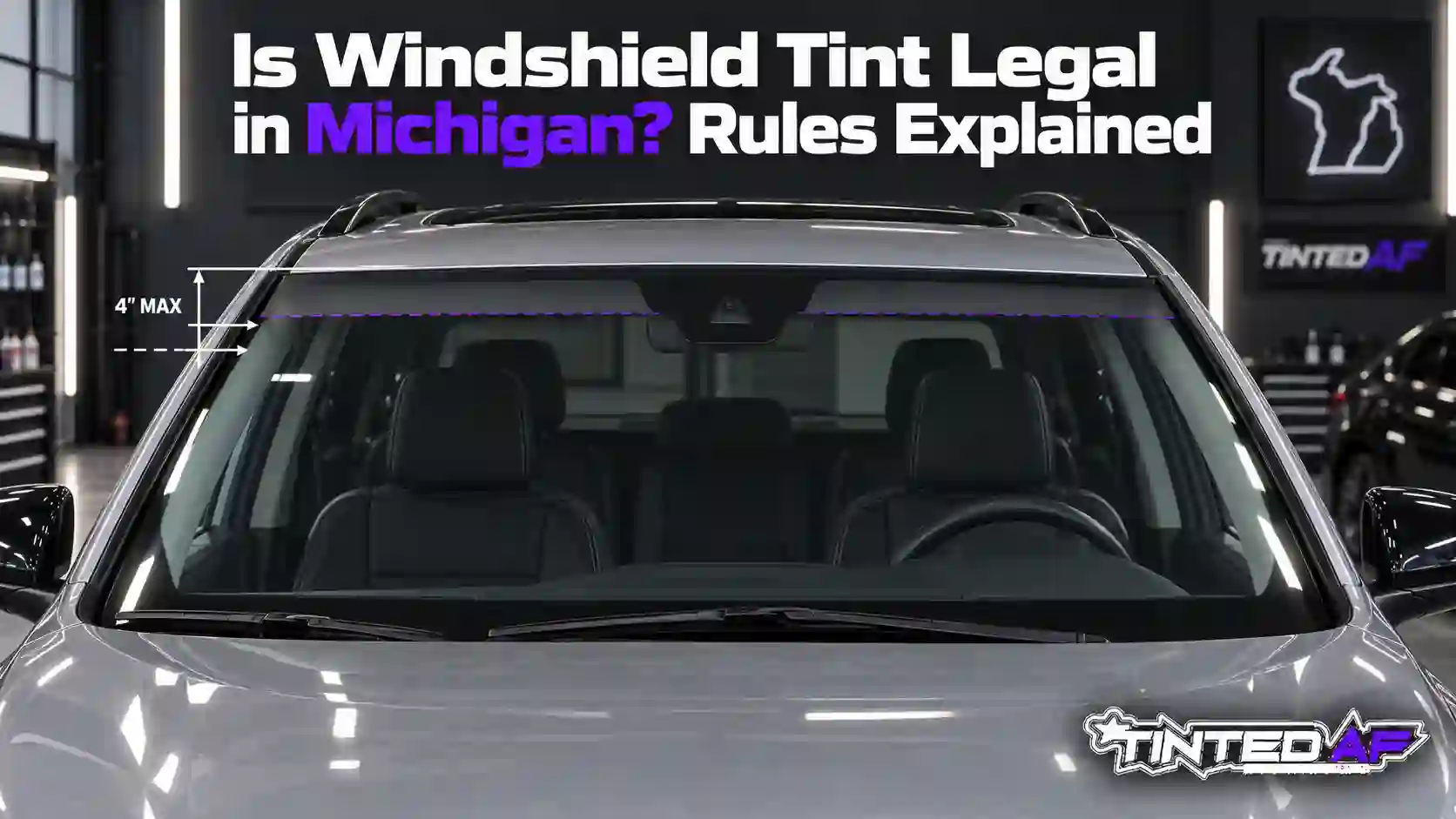
Windshield tint is legal in Michigan, but only within a narrow strip. Most drivers never read the fine print on where that strip ends. Every week, TintedAF fields questions from Dearborn Heights and Sterling Heights drivers who assumed the whole windshield was fair game. This guide breaks down exactly what Michigan law allows on a windshield, and what options exist beyond a basic strip.
Is Windshield Tint Legal in Michigan?
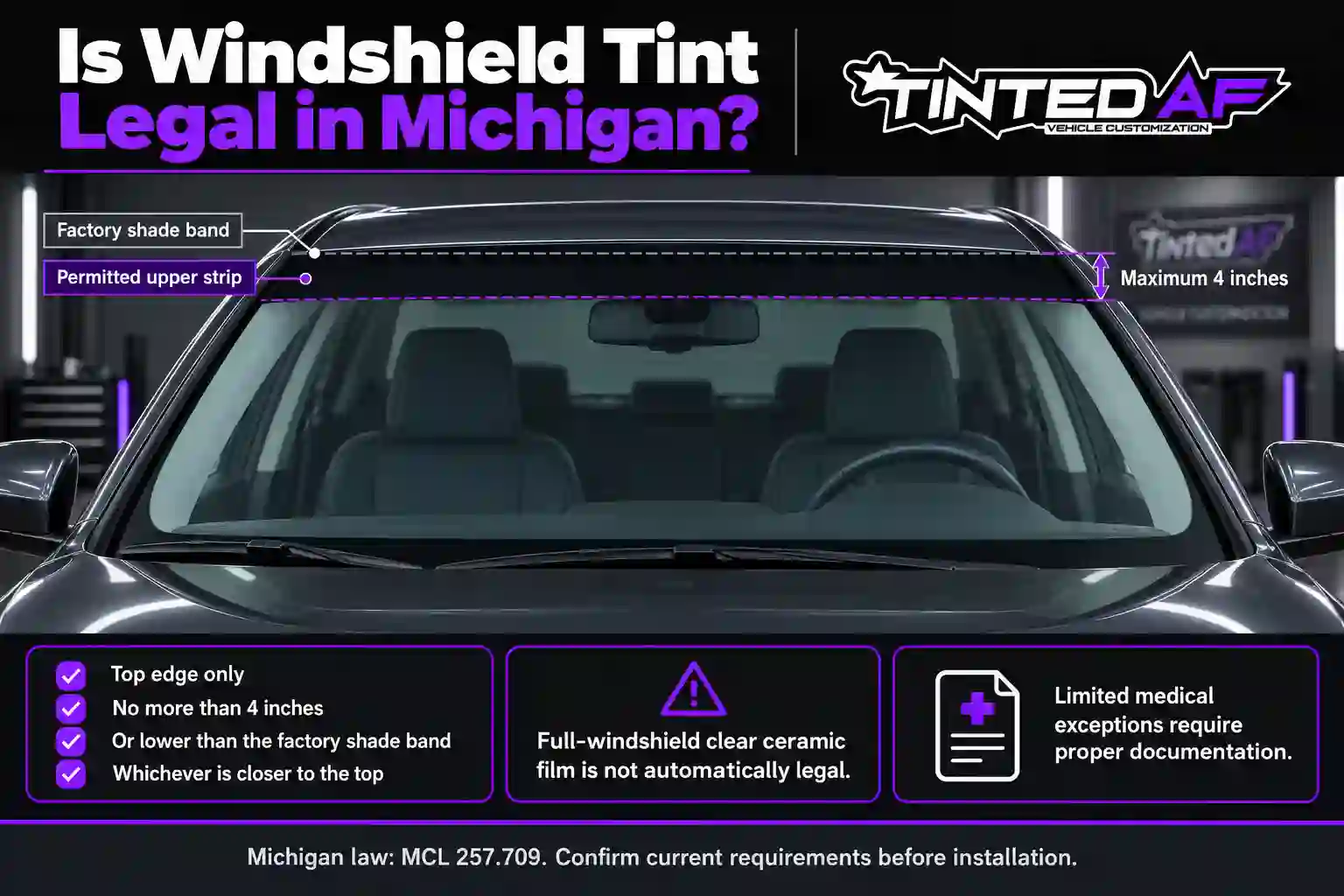
Yes, windshield tint is legal in Michigan, but only in a narrow band at the top of the glass. State law permits non-reflective film along the top edge of the windshield. That film cannot extend more than 4 inches down. It also cannot extend past the factory shade band, whichever line is closer to the top.
Anything beyond that strip is illegal on a standard visible-tint film. A separate category, clear ceramic infrared film across the full windshield, is treated differently. This guide covers that option later.
Some drivers notice a faint gray or green cast across the whole windshield. They assume it is illegal aftermarket tint. Most of the time, that shade is factory-applied glass tinting. It is not covered by the aftermarket tint statute at all.
Has Michigan’s Windshield Tint Law Changed Recently?
The core windshield rule under MCL 257.709 has stayed the same for years. It limits non-reflective film to the top 4 inches or the shade band. Drivers who saw a different rule online may have read a different state’s law by mistake. Tint rules vary widely by state.
What Is Michigan’s Windshield Tint Strip Rule?
Michigan Compiled Laws 257.709 governs what can go on a windshield. The law allows a tinted film “along the top edge of the windshield” within 4 inches of the top. It also cannot sit lower than the shade band, whichever point sits closer to the top.
At TintedAF, installers measure this line on every vehicle before making a single cut. Factory shade bands vary between a sedan, an SUV, and a pickup, so a one-size cut does not work. Even a one-inch measurement error can turn a legal strip into a citation.
Where Is the AS-1 Line on Your Windshield?
Most windshields carry a small etched “AS-1” mark near the top edge, left there by the glass manufacturer. Installers commonly use this AS-1 line as a practical reference point for the shade band. It usually sits close to where the factory tint coating already ends.
The AS-1 line is a manufacturing mark, not a legal boundary written into the statute itself. It lines up closely enough that most shops treat it as the safe cutoff.
Does the Tint Have to Be Non-Reflective?
Yes. Michigan’s front-window rules generally bar reflective or mirrored film on the front glass. That standard carries over to the windshield strip. A mirrored or metallic-finish strip risks a violation, even inside the correct 4-inch zone.
Windshield Tint vs. Front Side Window Tint: Why Drivers Get This Confused
Searches for “front window tint law” often mean two different things. Some drivers mean the windshield itself; others mean the driver and front passenger side windows. Michigan treats both under the same general strip rule: a top 4-inch shade band.
The outcome still differs once color and percentage come into play. Front side windows get evaluated on visibility and reflectivity rather than a fixed percentage. Rear windows and the rear windshield can run any VLT darkness, as long as reflectivity stays under 35 percent. For every window position, see Michigan’s window tint law for every window, not just the windshield.
This page focuses specifically on the windshield itself. It is the one piece of glass with its own placement rule and its own set of misconceptions. Drivers who landed here looking for side or rear window rules will find that companion guide more useful.
Can You Tint the Entire Windshield in Michigan?
A standard visible-tint film across the full windshield is not legal in Michigan. Anything past the 4-inch strip or shade band violates the placement rule, no matter how light the shade looks.
A different product exists for whole-windshield coverage. Clear ceramic infrared film doesn’t visibly darken the glass, and it doesn’t create a reflective surface. TintedAF installs Geoshield ceramic IR film across full windshields for Michigan drivers who want heat and UV protection. It does this without touching the strip rule.
Clear Ceramic Film vs. a Visible Tint Strip
A visible tint strip changes how the glass looks, and it is capped at 4 inches. Clear ceramic film runs the full windshield instead. It blocks a large share of infrared heat and UV, while staying close to factory clarity. One is cosmetic glare control at the top edge. The other is heat rejection across the whole windshield.
What Tint Percentage Is Legal on a Michigan Windshield Strip?
Michigan does not set a specific VLT percentage for the windshield strip itself. The law controls placement and reflectivity, not a darkness number. That is different from how rear and side windows get regulated.
In practice, most windshield strips installed in Michigan run between 20 and 50 percent VLT. Drivers choose that range for glare reduction, not because the law requires it. For the rest of the vehicle, see how dark Michigan drivers can legally go.
Can You Get a Medical Exemption for Windshield Tint in Michigan?
Michigan law allows a special window treatment for drivers who are light sensitive or photosensitive. The exemption must be properly documented. It applies to window treatments generally, the same provision that covers front side windows.
The exemption does not automatically waive the placement limit on every windshield in every case. Drivers considering broader coverage for a medical condition should confirm the scope with a licensed installer first.
What Documentation Do You Need to Carry?
Michigan requires a signed letter from a physician or optometrist. That letter must state the window treatment is a medical necessity for a light-sensitive condition. It has to stay in the vehicle at all times, since an officer can ask for it during a stop.
Who Typically Qualifies for This Exemption?
Commonly cited qualifying conditions include lupus, other photosensitive skin conditions, and certain retinal or corneal disorders. Migraines triggered by bright light are also commonly cited. A licensed physician or optometrist makes the final call, not the vehicle owner or the installer.
Are Purple or Colored Windshield Tints Legal in Michigan?
Michigan’s tint statute does not name specific banned colors for windshield film. It focuses on placement and reflectivity instead. Red, amber, and blue finishes still commonly draw extra scrutiny during a stop. Officers watch for those colors since they can resemble emergency vehicle equipment.
Purple tint is not automatically illegal on its own. A heavily tinted or reflective purple strip past the 4-inch line carries the same risk as any other color. A standard, non-reflective film inside the legal strip avoids the question altogether.
Common Mistakes Michigan Drivers Make With Windshield Tint
The most frequent mistake is measuring from the dashboard or the rearview mirror mount. That is not the true top edge of the glass. This habit pushes a strip past the legal 4 inches without the driver realizing it. A second common error is assuming any home-tint-kit film qualifies as non-reflective. Many bargain films actually carry a visible metallic sheen.
A third mistake is skipping the shade band check entirely. Cutting a flat 4-inch strip still violates the rule on a vehicle where the factory shade band sits higher. Professional measurement against the actual shade band avoids all three problems at once.
Why Michigan Drivers Add Windshield Tint in the First Place
Michigan’s driving conditions push windshield tint questions in two directions at once: glare in winter, heat in summer. A strip and a full clear ceramic film solve different halves of that problem.
Winter Glare on Metro Detroit Highways
Metro Detroit’s low winter sun creates sharp glare on morning and evening commutes. Corridors like I-96, I-94, and M-10 catch that glare right at windshield height. A properly placed strip cuts the glare without blocking the driver’s forward view. That matters most during the shortest daylight months.
Summer Heat and Dashboard UV Damage
Summer brings the opposite problem. UV exposure through an untreated windshield fades dashboards and cracks trim over several Michigan summers. That is where full-windshield clear ceramic film earns its cost, since it targets heat and UV rather than glare alone.
How Professional Windshield Tint Installation Works
Windshield glass curves in more than one direction. A strip or a full sheet of film has to stretch and settle into that curve. It cannot trap air or wrinkle at the edges. That compound curve is the main reason windshield work takes longer than a flat side window.
Modern windshields also carry rain sensors and forward-facing cameras behind the glass, near the rearview mirror. These support features like lane-keep assist and automatic emergency braking. Installers have to mask around these components carefully. Film placed over a sensor can interfere with how it reads the road. The car window tinting in Sterling Heights team checks sensor placement on every vehicle before starting a windshield job.
What to Expect After Installation
Fresh windshield film needs a curing period before it reaches full clarity. That period often runs several days, depending on temperature and film type. Drivers may notice a slight haze or small water pockets during this window. That is normal and not a sign of a failed install.
How Long Does Windshield Tint Last in Michigan?
A properly installed windshield strip or full clear ceramic film typically lasts several years. Fading, bubbling, or peeling should not show up before then. Exact timelines still depend on film quality and installation. Michigan’s freeze-thaw winters and summer heat swings put more stress on windshield film than milder climates do.
Cheap, non-automotive film tends to fail first, sometimes within a Michigan winter or two. Professionally installed ceramic film lasts much longer under the same conditions. For a detailed breakdown of how long different film types last, see how long window tint typically lasts in Michigan.
What Happens If You Get Pulled Over for Illegal Windshield Tint?
Michigan treats illegal window tint as a civil infraction, not a moving violation. It does not add points to a driving record. Drivers can still expect a fine, typically $115 to $150, including court costs.
Repeat violations sometimes trigger a mandatory removal order, requiring proof the illegal film has been taken off. Most officers spot a violation visually during a stop. They check how far the strip extends past the top of the glass. The full statutory language sits in Michigan Compiled Laws 257.709, the primary source behind every rule in this guide.
This guide covers passenger vehicle windshield tint only. Motorcycle windshield and eye-protection rules fall under a separate section of Michigan traffic law.
Windshield Tint vs. Side Window Tint: Michigan’s Rules at a Glance
Michigan does not apply one blanket rule across the whole vehicle. Each window position carries its own mix of placement, darkness, and reflectivity requirements, summarized below.
| Window Position | What Michigan Law Allows | Reflectivity Limit | Medical Exemption |
| Windshield (top strip) | Non-reflective film in the top 4 inches or to the shade band, whichever is closer to the top | Must be non-reflective | Yes, with physician or optometrist letter |
| Windshield (full sheet) | Clear ceramic IR film generally accepted since it does not visibly tint or reflect | Not applicable | Not applicable |
| Front side windows | No fixed VLT minimum; must preserve clear vision | Same non-reflective standard as windshield | Yes, with physician or optometrist letter |
| Rear side windows | Any VLT darkness permitted | Must stay under 35 percent reflectance | Not needed, already unrestricted |
| Rear windshield | Any VLT darkness permitted | Must stay under 35 percent reflectance | Dual side mirrors required if view is blocked |
Conclusion
Michigan windshield tint law comes down to two rules. A strip is capped at 4 inches or the shade band, whichever sits closer to the top. Clear ceramic film across the full windshield is treated differently in practice, since it does not visibly tint or reflect. Colors, medical exemptions, and enforcement all build on those two points.
Drivers weighing options for the rest of the vehicle should treat each window separately. One rule does not cover the whole car. See picking the right window tint percentage in Michigan for that breakdown. TintedAF’s Dearborn Heights and Sterling Heights shops handle both the legal strip and full clear ceramic windshield film. Drivers who want to get this right the first time can start there.
Frequently Asked Questions
What’s the actual difference between a windshield tint strip and tinting the whole windshield in Michigan?
A strip is a visible film capped at 4 inches from the top, or the shade band, whichever is closer. A full-windshield option uses clear ceramic IR film instead, staying nearly transparent to the eye. It blocks heat and UV without triggering the 4-inch placement limit that governs a dyed strip.
How far down can you legally tint a windshield in Michigan?
Michigan law allows non-reflective film no more than 4 inches from the top of the windshield, under MCL 257.709. It can also stop at the shade band if that line sits higher. A professional installer measures each vehicle before cutting, since shade bands differ by make and model.
Can I get a medical exemption to tint more of my windshield in Michigan?
Michigan allows a medical window treatment exemption for drivers who are light sensitive or photosensitive. It requires a signed letter from a physician or optometrist kept in the vehicle. Confirm full-windshield coverage under this exemption with a licensed installer first.
Is purple or colored tint legal on a Michigan windshield?
Michigan’s statute does not ban specific colors by name for windshield film. It focuses on placement and reflectivity instead. Red, amber, and blue finishes still draw extra scrutiny during a stop. Any color used must still follow the same 4-inch placement rule as a standard strip.
Can Michigan police pull you over just for windshield tint?
Yes, illegal windshield tint is a civil infraction in Michigan, not a moving violation. It typically carries a $115 to $150 fine, including court costs. No license points get added to a driving record. Repeat violations can trigger a mandatory removal order, and you must provide proof in court.
What VLT percentage should I pick for a Michigan windshield tint strip?
Michigan sets no legal VLT minimum for the windshield strip itself, only placement and non-reflective rules. Most Michigan drivers choose a 20 to 50 percent VLT strip for glare control. Full-windshield heat protection typically comes from clear ceramic film instead of a darker visible strip.