
Key Takeaways
- PPF is a thick, self-healing urethane film that absorbs rock chips and road debris. Ceramic coating is a thin chemical layer that adds gloss and repels water.
- Ceramic coating does not provide the physical impact protection of PPF, no matter what its hardness rating claims.
- Typical 2026 Metro Detroit pricing runs $1,500 to $3,000 for full-front PPF and $500 to $3,000 for a professional ceramic coating.
- Many owners combine both, with PPF on high-impact panels and a film-safe ceramic coating over the film and remaining paint.
- The choice between paint protection film and ceramic coating depends on driving habits, budget, and how long you’ll keep the car.
Every Metro Detroit driver protecting new paint eventually faces the PPF vs ceramic coating question. Paint protection film physically blocks rock chips and scratches. Ceramic coating adds gloss, repels water, and makes washing easier.
The installers at TintedAF apply both products every week in Dearborn Heights and Sterling Heights. This guide covers what each one protects against, what each costs in 2026, and when combining them makes sense.
What Is the Difference Between PPF and Ceramic Coating?
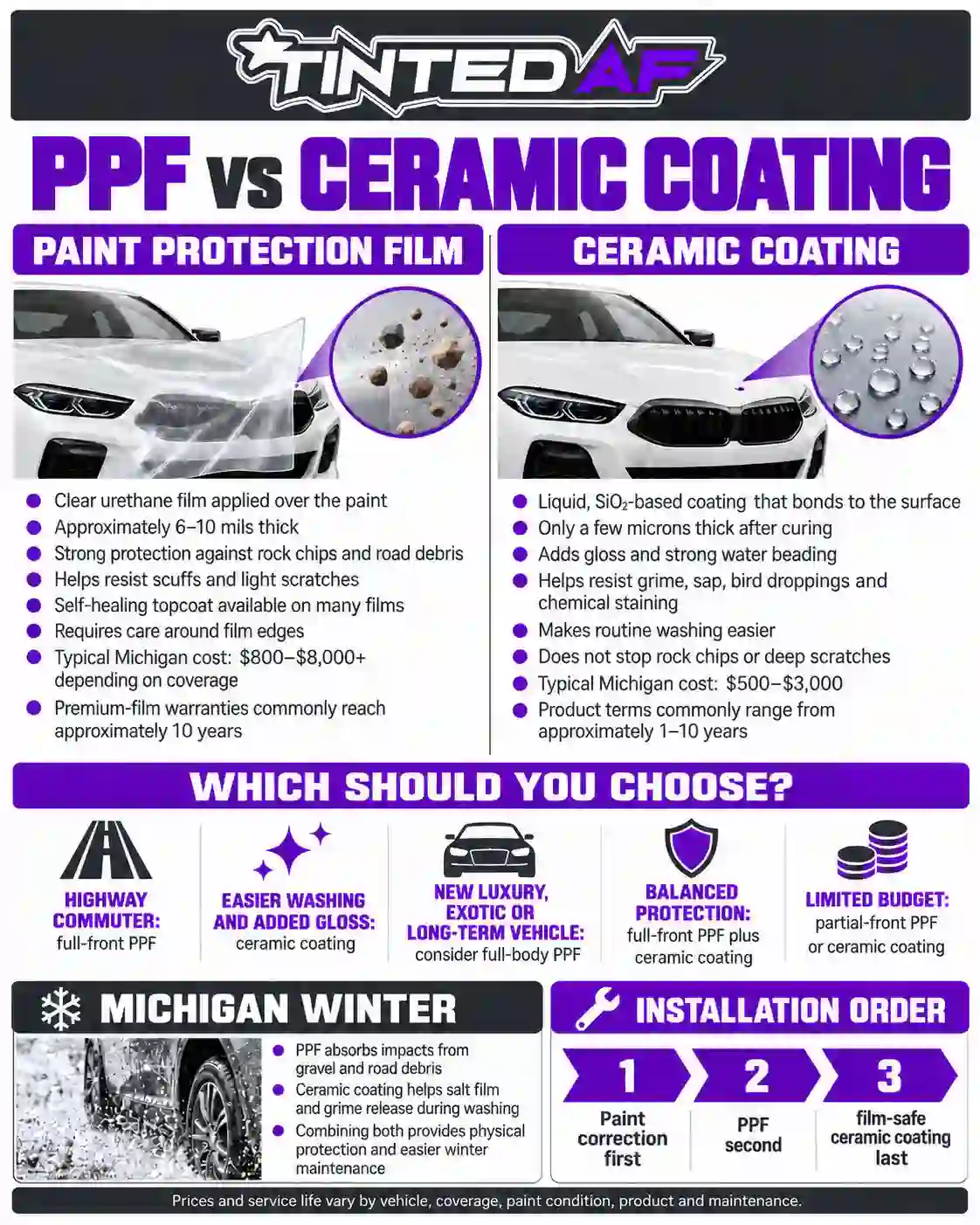
The main difference between PPF and ceramic coating is physical protection versus chemical protection. Paint protection film, also called a clear bra, is a clear thermoplastic urethane film applied over automotive paint. It absorbs impacts from rock chips and road debris before they reach the clear coat.
Ceramic coating is a liquid, usually built on silicon dioxide (SiO2), that cures into a hard, thin layer. It bonds to the clear coat and makes the surface slick, glossy, and hydrophobic. That layer resists etching and contamination, but it is far too thin to stop a stone at highway speed.
Thickness explains most of the gap. Premium films measure roughly 6 to 10 mils, while a cured coating is only a few microns thick. Drivers comparing clear bra and PPF installation in Michigan should treat film as impact protection and coating as easy-care protection.
What Does Paint Protection Film Protect Against?
PPF is built to take hits. The film flexes and absorbs energy from rock chips, gravel, sand, and road debris thrown by trucks and tires. It also blocks scuffs on door edges, door cups, and loading areas.
Most modern films are self-healing film. Their top coat can close light swirl marks and fine scratches when warmed by sunlight or warm water. Deep cuts won’t heal, but the paint underneath stays untouched.
Quality films also resist yellowing, shield the paint below from UV exposure, and often carry a hydrophobic top coat. STEK, for example, warranties its 8-mil DYNOshield film for 10 years against yellowing, cracking, bubbling, and delamination. At both Michigan shops, TintedAF maps film coverage to how each vehicle is actually driven.
What Does Ceramic Coating Protect Against?
Ceramic coating protects against chemical and environmental damage. It resists bird droppings, bug splatter, tree sap, road grime, and water spots long enough for a safe wash. It also helps slow UV fading and oxidation on exposed paint.
Its biggest daily benefit comes from hydrophobic properties. Water beads and sheets off, carrying dirt with it, so the car stays cleaner and dries faster. The slick finish also reduces light marring during careful hand washes.
Ceramic coating does not provide the same physical impact protection as PPF. A 9H rating refers to a pencil hardness test, not resistance to a flying stone. Rock chips, deep scratches, and door dings pass straight through a coating to the paint below.
Is PPF Better Than Ceramic Coating?
PPF is better than ceramic coating at preventing rock chips, scratches, and road-debris damage. Ceramic coating is better for gloss, water beading, and easier vehicle maintenance at a lower price. Neither product wins every category, so the right answer depends on priorities.
Highway commuters, new-car owners, and anyone tired of touch-up paint usually get more value from PPF on the front end. Drivers who mainly want a cleaner, shinier car that washes easily often choose ceramic coating alone.
Installers at TintedAF recommend starting with the damage a car will actually see. A Metro Detroit freeway commuter faces constant gravel spray every week. A garage-kept weekend car mostly needs gloss and contamination resistance.
PPF vs Ceramic Coating Comparison Table
This side-by-side ceramic coating vs PPF comparison shows how the two products differ across the factors drivers ask about most.
| Factor | Paint Protection Film (PPF) | Ceramic Coating |
| What it is | Clear urethane film applied to panels | Liquid SiO2 coating that cures on paint |
| Thickness | Roughly 6 to 10 mils | A few microns |
| Rock chips and road debris | Strong protection, its main purpose | No meaningful impact protection |
| Light scratches and swirl marks | Self-healing top coat on most films | Reduces light wash marring only |
| Bird droppings, sap, water spots | Good resistance | Strong resistance |
| UV exposure | Shields paint under the film | Helps slow fading and oxidation |
| Hydrophobic properties | Moderate, stronger on coated films | Strong water beading |
| Gloss and finish | Clear gloss or matte options | Adds depth and slickness |
| Maintenance | Gentle washing, care near edges | Easy washing, periodic boosters |
| Removal | Peels off with heat when needed | Removed by machine polishing |
| Typical 2026 Michigan price | $800 to $8,000+ by coverage | $500 to $3,000 by package |
| Warranty terms | Often around 10 years on premium film | About 1 to 10 years by product tier |
Warranty terms come from manufacturers and cover defined defects, not every type of damage.
Full-Front, Partial, or Full-Body PPF: How Much Coverage Makes Sense?
Partial front PPF covers a bumper, mirrors, and the leading portion of a hood and fenders. It protects the most-hit zones at the lowest cost. The trade-off is a film edge that can show across the hood.
Full-front PPF covers the entire hood, full fenders, bumper, headlights, and mirrors, so no line crosses the hood. It is the most popular choice because it protects the whole leading edge. Track packages add rocker panels and A-pillars that catch spray from the tires.
Full-body PPF covers every painted panel, including doors and the rear bumper. It suits exotic, luxury, and long-term owners who want to preserve every panel. Many owners pair full-front film with ceramic coating on the remaining panels instead.
How Much Does PPF Cost Compared to Ceramic Coating in 2026?
PPF costs more than ceramic coating because the film costs more and every panel is cut and fitted by hand. In Metro Detroit, 2026 pricing for full-front PPF typically runs $1,500 to $3,000. A professional ceramic coating runs about $500 to $3,000, depending on the package.
| Service | Typical 2026 Michigan Range | What Changes the Price |
| Partial front PPF | $800 to $1,800 | Vehicle size, bumper complexity |
| Full-front PPF | $1,500 to $3,000 | Wrapped edges, headlights, film line |
| Track package PPF | $2,500 to $4,500 | Rockers, A-pillars, extra panels |
| Full-body PPF | $5,000 to $8,000+ | Vehicle size, exotic or luxury body |
| Basic ceramic coating | $500 to $1,000 | Single layer, light paint prep |
| Mid-tier ceramic coating | $1,000 to $1,800 | Multiple layers, deeper correction |
| Premium ceramic coating | $1,800 to $3,000 | Full paint correction, longer warranty |
| Full-front PPF plus ceramic coating | About $2,500 to $4,800 | Bundle pricing, coating tier chosen |
These ranges reflect published 2026 Metro Detroit shop pricing and line up with national 2026 comparisons. Final prices vary by vehicle size, paint condition, product brand, and correction needs. A written quote after an in-person inspection is the only reliable number.
How Long Does Installation Take for PPF vs Ceramic Coating?
PPF installation takes longer because technicians clean, fit, and trim each panel by hand. A partial front kit can often be finished in a day. Full-front jobs usually take one to two days, and full-body PPF may take three to five days.
Ceramic coating timelines depend mostly on paint correction. A new car may need a day, while a swirled daily driver may need two or three. Most coatings also need about a week before the first wash so the layer can fully cure.
Paint correction matters for both products. Film and coating each seal in whatever sits underneath, including swirl marks, haze, and light scratches. A careful polish before installation is what makes either product look right for years.
How Long Do PPF and Ceramic Coating Last?
Lifespan depends on product quality, installation, climate, storage, and upkeep, so no honest shop can promise an exact number. Manufacturer warranties give the clearest benchmark. Premium films commonly carry warranties around 10 years against yellowing, cracking, bubbling, and peeling.
Ceramic coating warranties vary much more by tier. Entry products may carry about 1 to 2 years, mid-tier products around 3 to 5 years, and flagship systems longer. A warranty covers defined defects, not guaranteed performance against every road hazard.
Michigan conditions shorten real-world life for both products. Salt brine, freeze-thaw cycles, and summer UV wear top layers faster than in milder climates. Garage parking, gentle washing, and periodic boosters help both products perform closer to their rated terms.
How Do Maintenance Needs Differ Between PPF and Ceramic Coating?
Both products need regular washing, and neither makes a car maintenance-free. Ceramic coating is easier day-to-day because dirt releases quickly and water beading speeds up drying. Most coatings benefit from a compatible booster or topper every few months.
PPF needs a little more care around its edges. Keep pressure washer nozzles back from film edges, and avoid harsh solvents or abrasive polishes that can dull the top coat. Bird droppings and sap should come off quickly, even on film.
A simple routine suits both products. Hand wash with a pH-neutral shampoo, use clean microfiber towels, and skip automatic brush washes. Cars with film and coating together get the easiest routine, since the coating keeps the film slick and clean.
How Do PPF and Ceramic Coating Change the Look of a Car?
Ceramic coating adds visible depth, gloss, and a slick feel without changing the color. It also locks in whatever sits underneath, so paint correction usually comes first to remove swirl marks and haze.
Quality gloss PPF is nearly invisible on most colors once installed. Edges can show up close, especially on partial kits, and wrapped edges reduce that. Matte PPF can turn gloss paint into a satin look while protecting it.
Film looks its best with a coating on top, since the coating adds gloss and slickness to the film surface. Color PPF is another option for owners who want a color change along with chip protection.
Can You Combine PPF and Ceramic Coating on the Same Car?
Yes, PPF and ceramic coating work well together, and many owners choose both. The usual approach is to put film on high-impact panels and apply ceramic coating over the film and the remaining paint.
Applying Ceramic Coating Over PPF
You can apply ceramic coating over PPF once the film has cured, following the installer’s timing. A coating rated for film adds hydrophobic properties, stain resistance, and gloss to the film surface. STEK, for example, says its Final Coat ceramic coating extends its DYNOshield warranty from 10 to 12 years.
Can PPF Go Over an Existing Ceramic Coating?
Film adhesive bonds poorly to a slick coated surface. Installers usually polish the coating off panels receiving film, then install PPF and recoat. The best order is paint correction first, PPF second, and ceramic coating last.
Should a New Car Get PPF, Ceramic Coating, or Both?
A new car is the best time for either product, before the paint collects chips or swirl marks. Even new cars can arrive with light dealer-wash marring, so start with a quick paint inspection.
Daily Highway Commuters
Full-front PPF plus ceramic coating on the rest usually gives the best balance. The front end gets chip protection, and the whole car becomes easier to wash through winter.
Leased Vehicles
Partial or full-front PPF may help reduce excess-wear charges for front-end chips at lease return. Ceramic coating alone suits low-mileage leases driven mostly around town.
Luxury, Exotic, and EV Owners
Full-body PPF with a coating on top protects every panel and preserves original factory paint. Factory finishes can be hard to match after repairs, so full coverage appeals to long-term owners.
Budget-Focused Drivers
Ceramic coating alone or partial front PPF offers a practical starting point. Film can be added later, although coated panels need prep before installation.
How Do Liquid PPF, Windshield Film, and Vinyl Wraps Compare?
Liquid PPF is a thicker liquid-applied layer that cures without seams or film edges. It resists light scratches better than a standard coating. However, it does not match urethane film against real rock chips, and it is harder to remove.
Windshield protection film is a separate, optically clear film for glass that reduces chips and pitting. A glass ceramic coating improves rain beading but offers no impact protection.
Vinyl wraps change a car’s color and add light scuff resistance. Standard vinyl is thinner than PPF and usually not self-healing, so it is not a substitute for a clear bra.
Which Holds Up Better Against Michigan Road Salt and Winter Roads?
Michigan winters test both products differently. Salt brine and grit settle on every panel, while plows and trucks throw gravel at the front end. PPF handles the impacts, and ceramic coating helps salt film and grime rinse off faster.
Chips matter more here than in warm states, because salt can start corrosion once a chip exposes bare metal. According to AAA research on road de-icer rust damage, U.S. drivers pay about $3 billion a year in rust repairs, and AAA advises repairing paint chips that expose bare metal.
For daily commuters on I-94, I-75, and I-696, film on the front end prevents many of those chips from forming. A coating over the rest of the car makes spring salt cleanup much easier.
Conclusion
PPF vs ceramic coating comes down to impact protection versus easy-care gloss. Film stops rock chips, road debris, and light scratches, while coating adds hydrophobic properties, UV resistance, and shine. For Michigan commuters, full-front PPF paired with ceramic coating often covers both needs.
The TintedAF team can inspect the paint, explain coverage options, and recommend the mix that fits each car and budget. Drivers still weighing panel coverage can compare costs and trade-offs in this full-front vs full-body PPF guide for Michigan drivers.
Frequently Asked Questions
Is PPF or ceramic coating better for Michigan winters and road salt?
PPF is better against winter rock chips and gravel, while ceramic coating helps salt film and grime rinse off faster. Chips that reach bare metal can rust quickly in Michigan salt. Many Metro Detroit drivers choose full-front PPF on the nose and ceramic coating on every other panel.
Can you put ceramic coating over PPF, and is it worth it?
Yes, you can apply ceramic coating over PPF once the film cures, using a coating made for film. It adds gloss, water beading, and stain resistance, and it makes washing easier. Some film brands, such as STEK, even extend the film warranty when you apply their matching coating over it.
How much more does PPF cost than ceramic coating in Michigan?
Full-front PPF typically runs $1,500 to $3,000 in Metro Detroit in 2026. Full-body PPF can reach $5,000 to $8,000 or more, while ceramic coating runs about $500 to $3,000. Vehicle size, coverage area, paint correction needs, and the film or coating brand move the final price most.
Will ceramic coating stop rock chips from highway driving?
No, ceramic coating will not stop rock chips, because the layer is only a few microns thick. A 9H rating measures pencil hardness, not impact resistance, so highway stones can still reach the paint. Only PPF adds real physical protection against rock chips and flying road debris.
Should I get PPF or ceramic coating on a brand-new car?
A new car is the ideal time for both, before chips and swirl marks start to build up. Highway drivers get the most value from full-front PPF plus ceramic coating on the rest. Budget-minded owners can start with ceramic coating alone and add front-end film later after proper prep.
Can you apply ceramic coating to matte or color PPF?
Yes, matte and color PPF can both be ceramic coated, but the product matters. Matte film needs a coating made for satin finishes, since a gloss coating can add unwanted shine. A film-safe coating adds water beading and stain resistance while keeping the film’s original look intact.